gobank-workflow
Banking workflow engine -- idempotent daily processing, business date management, and persistent run tracking.
Pages
- Demo app -- the workflow engine as an app, running in your browser: Workflows menu with instances and definitions, a simulation driver to make days happen, and a DB explorer over the live schema
- Daily processing demo -- interactive simulation of daily workflow processing with timing chart
- Release pipeline demo -- step through shipping a new gobank version; inject a failure and watch the resume retry only the failed stage
- Writing workflows -- the authoring contract: definitions, stages and waiting, resume and what it demands of a stage, what the host supplies, testing, drawing, a worked example and a checklist
- Database schema -- the tables, their keys and every column, with the migration that added it
- Comparison with other workflow engines -- Go libraries and the larger systems (Temporal, Camunda, Flowable, Spring Batch) set against this one: feature matrices, the closest relatives, and the gaps worth closing
- Changelog
- Roadmap
Overview
gobank-workflow is the timing and orchestration layer for the gobank ecosystem. It wraps gobank-products' simulation engine with:
- Idempotent daily processing --
Runner.RunDaily(date)is a no-op if already completed - Business date management -- decouples processing date from calendar date
- Persistent run tracking -- SQL-backed store records every run and per-account step results
- Catch-up --
Runner.CatchUp(from, to)fills gaps from the last completed date
Architecture
Runner.RunDaily(date)
  -> Store.FindRun(daily_update, date)  -- idempotency check
  -> if completed: return nil           -- no-op
  -> Store.CreateRun(pending)
  -> sim.AdvanceToDate(date)            -- gobank-products handles business logic
  -> Observer writes StepResults
  -> Store.CompleteRun()
Workflow definitions
Each definition is a kind of workflow the engine can run; each run recorded in the store is an instance of one. Definitions is the registry in code: it starts empty and each host program appends the workflows it runs, so its pages show those and no others. Store.CountRuns reports how many instances each definition has in every state. The demo app registers these four:
| Type | Description | Instance key | Steps |
|---|---|---|---|
daily_update |
End-of-day processing for one business date: the DayProcessor runs over every account |
business date | end_of_day, one per account |
release |
Ship a new version through the release pipeline; a failed stage stops the release and the next run resumes from it | version | check → bump → changelog → tag → push origin → push mirror → verify install → deploy docs |
payment_batch |
Pay a file of five payments; each payment is a child instance under the batch, which settles once they have all finished and fails if any failed | batch reference (PAY-0001) |
receive → start payments (sub-process, a payment child per payment, all at once) → settle (joins them) |
payment |
Pay one payment of a batch out of the paying account | batch reference/position (PAY-0001/3) |
check funds → post |
The batch and its payments are a master–detail pair: the batch's instance page lists its payments as children with their state, and each payment's page links up to its batch.
The diagrams below show only how the steps flow (the release pipeline drawn down, since eight steps across would read too small on this page); they are generated from the registry by cmd/defd2 and rendered with d2 at docs build time, so they cannot drift from the code. Each step is a link to the code that performs it. The demo app shows the same pictures, colours an instance's steps by state, and carries the detail in tables.
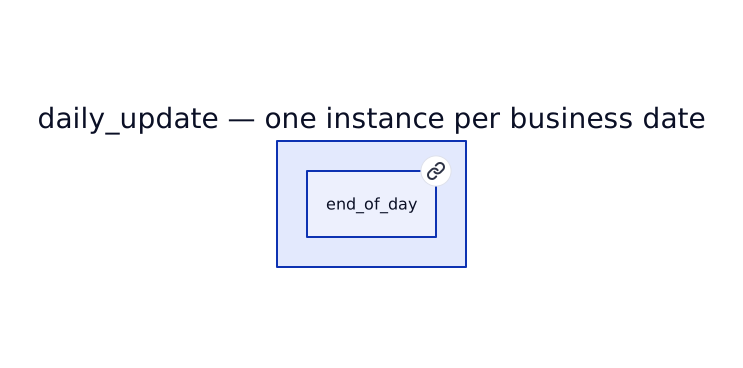



A definition is a sequence of steps; an instance is one run of it, identified within its type by the instance key, and each step recorded against the instance is one of the definition's steps. A retry is a new attempt at the same instance, not a new instance: Runner.RunDaily reprocesses every account, Runner.RunPipeline resumes from the failed stage.
An instance moves through these states:
| State | Meaning | Set by |
|---|---|---|
pending |
created, not yet started | Store.CreateRun |
running |
processing the date, or a pipeline stage | Runner.RunDaily on start; Store.ResumeRun when a waited-on condition holds |
waiting |
parked on a stage's Until condition; the host's next call re-enters the same attempt |
Store.WaitRun |
completed |
every step recorded; the date will never be re-run | Store.CompleteRun |
failed |
the DayProcessor or a pipeline stage returned an error; the instance is eligible for a retry |
Store.FailRun |
Writing workflows is the authoring contract for the next one.
Schema
The SQL schema is versioned with gobank-db expand/contract migrations. The SQL adapter lives in the sqlstore package so the core package stays free of database drivers. sqlstore.New applies sqlstore.Migrations in order and records each in schema_migrations; SchemaVersion in the core package is the version the code expects, and sqlstore.Store.SchemaVersion(ctx) is the version a database is at.
| Version | Name | Phase | Change |
|---|---|---|---|
| 1 | workflow runs and steps | expand | workflow_runs (one row per instance), workflow_steps (one row per step of a run) |
| 2 | instance keys and step status | expand | workflow_runs.instance_key with a unique index on (type, date, key) alongside the old one; workflow_steps.status and error_message |
| 3 | drop date-only uniqueness | contract | drops the (type, date) unique index that v2 superseded |
| 4 | run revisions | expand | workflow_runs.revision and step_names: the revision the latest attempt ran |
| 5 | fixed-width created_at | expand | pads created_at stamps written before v5 to the fixed-width layout, so text order is time order |
Versions 2 and 3 are one expand/contract pair: gobank-db's lint refuses a DROP INDEX in an expand migration, so the replacement index is added first and the old one removed in a separate contract step.
The tables and their columns are on the database schema page.
Demo app
The demo app is the same Go program as task demo serves on a workstation, compiled to WASM and run inside a service worker with lofigui: one http.ServeMux, two entry points. Its database is pglike in the browser's memory, migrated to the current schema version at start.
| Menu | Page | Shows |
|---|---|---|
| Workflows → Instances | workflows/instances |
the top-level runs in the store, active first then most recent; a child run is on its parent's page unless the filter names its purpose, workflow or key; each opens its state and the per-account steps |
| Workflows → Definitions | workflows/definitions |
the Definitions registry with instance counts by state; each opens its instances |
| Simulation | simulation |
the driver: advance 1, 7 or 30 business days, arm a failure for the next day, ship the next version through the release pipeline (optionally failing at a chosen stage), pay the next payment batch (optionally with one payment failing to post), reset |
| DB Explorer | internal/explorer |
tables, columns, indexes and rows of the live schema, including schema_migrations |
| About | about |
versions, schema version expected and applied, runtime |
A failed day stays current, a failed release keeps its version and a failed batch keeps its reference: the next advance, ship or pay retries the same instance, so there is always one instance per business date, one per version and one per batch. Paying a batch again retries its failed payments first, then settles the batch.
Demos
Both demos are Go compiled to WASM, rendered with lofigui.
The daily processing demo runs a simulated daily workflow with 1,000 Easy Access savings accounts (3.5% annual rate, 10,000.00 each). Click the buttons to advance time and observe processing duration per day.
The release pipeline demo models the pipeline that ships a new gobank version -- check, bump, changelog, tag, push origin, push mirror, verify install, deploy docs. The stages, and the task-plus code that runs each one for real under tp release, are shown below. Run it a stage at a time or to the end. Arm Fail next stage to inject a failure: the release halts at that stage, and resuming retries only that stage. Completed stages are never repeated, which is the same resume property the daily runner has for business dates.

Source: release-pipeline.d2.